
A College Asked Flock to Pull Its Cameras Over ICE Fears. Flock Said No, So Staff Covered Them in Trash Bags
Elgin Community College asked Flock Safety to remove its license plate cameras after ICE detained a student on campus. Flock refused, the college offered to pay out the contract, and staff ended up covering the cameras with trash bags.
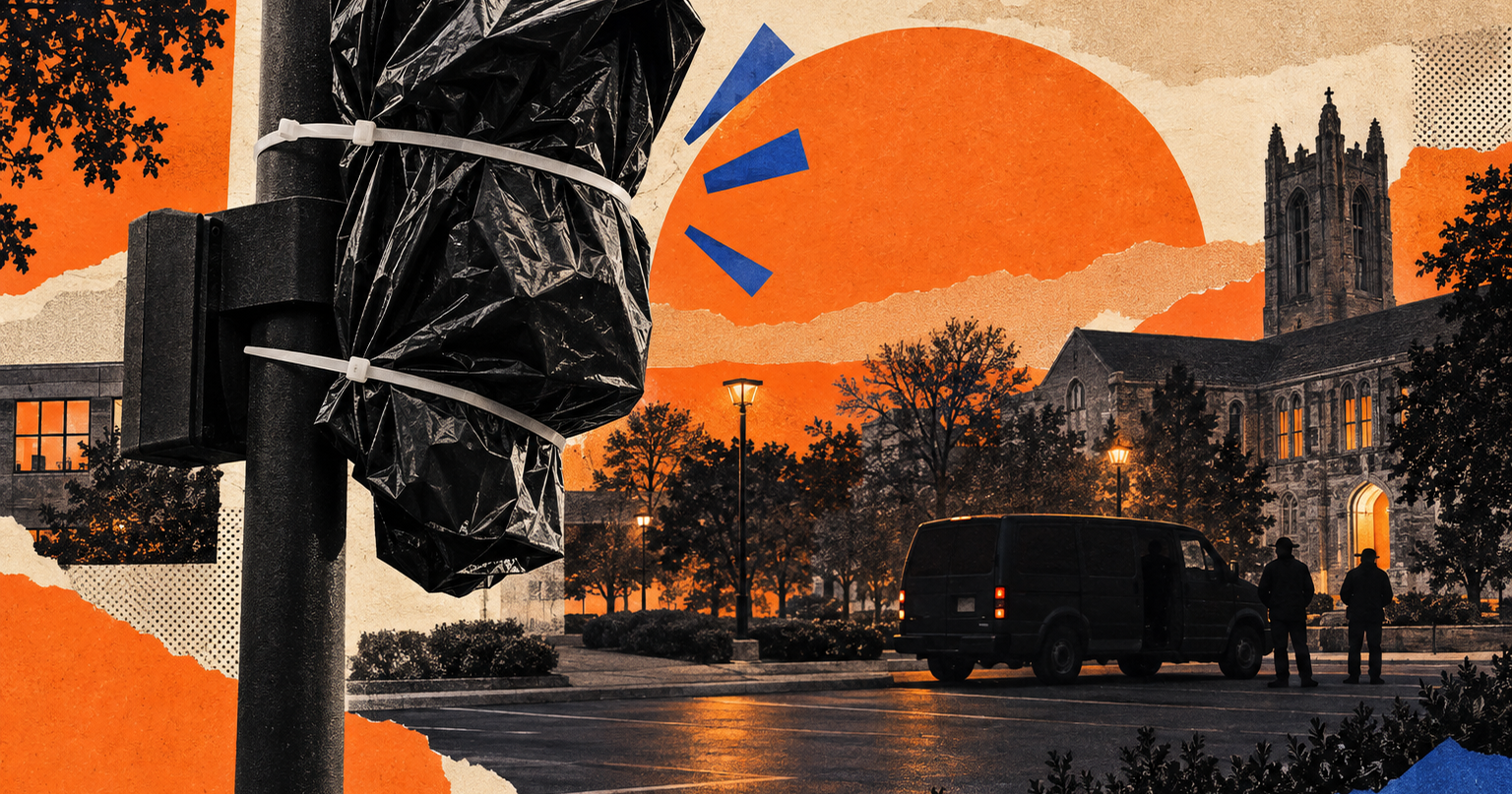
A public college outside Chicago decided it no longer wanted surveillance cameras watching its students. It told the company that owned them to take them down. The company said no, and for months the cameras stayed up on a campus that had asked them to leave.
Elgin Community College, in Chicago's far west suburbs, hired Flock Safety to install six cameras in April 2025. President Peggy Heinrich thought they would "enhance the safety and security of students," she told WBEZ and the Chicago Sun-Times. Flock's automatic license plate readers use AI to log the registration, model and details like dents and bumper stickers of every passing car. The pitch is finding stolen vehicles and missing people.
A campus that got scared
Then the mood changed. Heinrich grew worried after news reports that Flock data in Illinois had been shared with US Customs and Border Protection. In September 2025, ICE detained an ECC student in a campus parking lot.
More than half of ECC's students identify as Latino. Enrollment dipped, and students were afraid to come to class. Heinrich's staff audited the campus Flock data and found no evidence it had been accessed by federal immigration agents. Officials asked for the cameras to come down anyway, "out of an abundance of caution for our students."
In October 2025 the college told Flock it wanted to cancel. Within a day, Heinrich said, Flock rejected the request and refused to uninstall, on the grounds that the company had not breached the agreement. Flock owns its equipment, so the cameras were not the college's to remove.
In December, ECC offered to pay for the remaining five months of the contract. It just wanted the cameras gone. "We never received a response back from Flock," Heinrich said.
The trash bag standoff
So staff did what they could. They wrapped the cameras in black trash bags and zip ties. Workers in an unmarked vehicle, which Heinrich assumed belonged to Flock, kept coming back and stripping the coverings off.
"We were kind of in a back and forth for a bit where we'd cover, and then when they'd come to service, they'd remove," Heinrich said. "Then we'd cover and then they'd remove."
The ritual lasted until the contract expired in April 2026, when Flock finally uninstalled the cameras. The company did not respond to WBEZ's request for comment, and the Verge picked up the story over the weekend. Flock has said federal agencies, including ICE, can no longer access local Flock data unless law enforcement agencies grant access.
Why a vendor would fight to stay
Torin Monahan, a surveillance researcher at UNC Chapel Hill, argues the company has a financial reason to keep cameras collecting data even where they are unwanted. Clients shop for the network with the greatest reach, and every camera adds to it. "You get to access even more cameras throughout the country," he said.
That logic is colliding with a wider political mood. Flock is already cutting about 18% of its staff as a bipartisan backlash against its cameras grows, and the Elgin fight shows why customers are nervous.
Public records obtained by Monahan and WBEZ show Flock data at Joliet Junior College, the University of Illinois Chicago and the University of Illinois Urbana-Champaign was searched dozens of times last year in connection with immigration enforcement. In some cases, federal immigration authorities accessed the colleges' data directly. The Illinois Secretary of State found that CBP searched Illinois Flock data last year in violation of state law.
Flock readers still operate at five of Illinois' 12 public universities and four community colleges. Joliet Junior College has seven of them, with a contract up for renewal in July 2027. "It's kind of like a backstab to the students," said Lui Rodriguez, a 26 year old JJC student. "We're being surveilled and our information can be used to track us down and detain us."
JJC spokesperson Katie Smith said leaders and campus police proactively review who has access to the college's Flock data and would take any misuse seriously.
Some offers on this page may be paid placements or contain affiliate links.
Subscribe to Techpresso
Free daily newsletter, read in 5 minutes.
Subscribe free