
His Bots Streamed AI Songs Billions of Times and Collected $10 Million in Royalties. Now He's Going to Prison
A North Carolina musician built an army of bots to listen to hundreds of thousands of AI-generated songs, and the royalties came out of real artists' pockets. He just got 18 months.
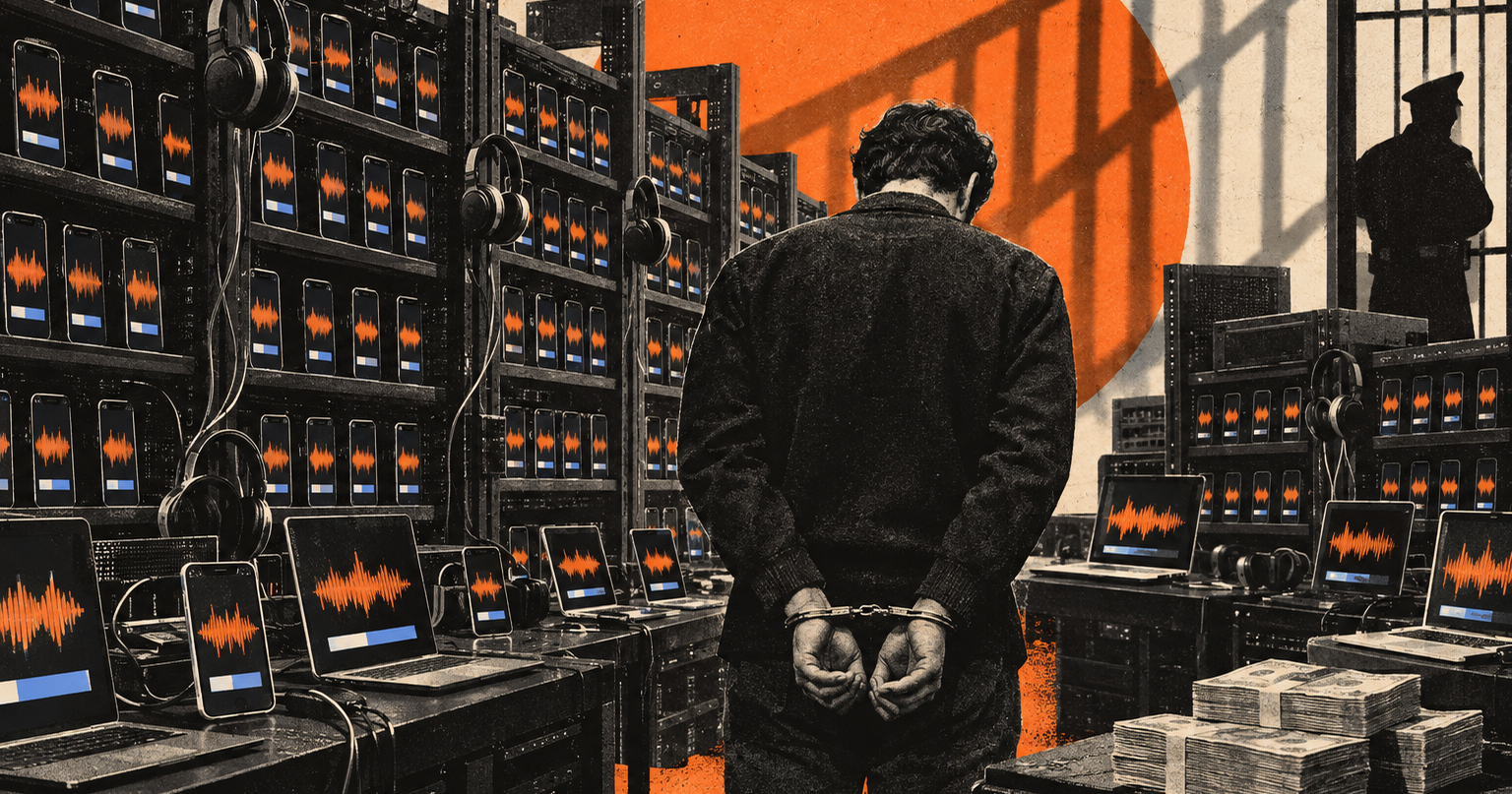
For seven years, Michael Smith's most devoted listeners were bots. Eventually, most of the songs they played weren't written by a human either.
Smith, a 54-year-old musician from North Carolina, has been sentenced to 18 months in federal prison plus two years of supervised release for a royalty scheme that pulled more than $10 million out of Spotify, Apple Music, Amazon Music, and YouTube Music. He was also ordered to forfeit $8,091,843.64. He was indicted in September 2024 and pleaded guilty in March 2026.
A spreadsheet for fake fans
The scheme ran from 2017 to 2024. Smith set up automated accounts that streamed his catalog over and over, routing them through VPNs so the platforms' anti-fraud systems wouldn't notice a few listeners with suspiciously bottomless appetites.
He did the math early. In an October 20, 2017 email to himself, he sketched out 52 cloud service accounts running 20 bots each, every bot playing about 636 songs a day. That worked out to roughly 661,440 streams a day, about $3,307 in daily royalties at half a cent per stream, and more than $1.2 million a year.
There was a catch. Billions of plays piled onto a small catalog look exactly like fraud. "We need to get a TON of songs fast to make this work around the anti fraud policies these guys are all using now," Smith wrote to accomplices on October 4, 2018.
Enter the AI
His fix was generative music. With help from the CEO of an AI music company and an unnamed promoter, Smith uploaded hundreds of thousands of AI-generated tracks bought from an accomplice. Spreading the fake streams thinly across a giant fake catalog made each song look like a modest little niche hit rather than an obvious anomaly.
At the peak he was running more than 1,000 bot accounts. In a February 2024 email, he bragged about "over 4 billion streams and $12 million in royalties since 2019."
Prosecutors offered a comparison that captures the absurdity. In April 2023, Taylor Swift's entire catalog drew 9.3 million family plan streams on YouTube Music. Smith's bots, using family plans of their own, streamed his AI music 80.9 million times that same month.
Who actually paid
It's tempting to read this as a victimless prank on giant tech platforms. It wasn't. Services like Spotify pay artists out of a shared royalty pool divided by each artist's share of total streams, so every fake play shrinks the slice that goes to real musicians.
"By flooding music streaming platforms with automated bots in the place of consumers, and fake songs in the place of creativity, Smith robbed millions in royalty payments from genuine artists and their fans," U.S. Attorney Jamie McDonald said.
The case lands while the music business is fighting AI on a second front. Sony Music Publishing and Warner Chappell are suing Anthropic over training Claude on song lyrics, arguing the models were built on their catalogs without permission. Smith's scheme shows the other half of the problem: once songs cost almost nothing to generate, the cheapest way to cash in is to flood the pool and let machines do the listening.
Some offers on this page may be paid placements or contain affiliate links.
Subscribe to Techpresso
Free daily newsletter, read in 5 minutes.
Subscribe free